
✅ What Is Happening in the Iran 10-Point Ceasefire Plan?
When I closely analyzed the Iran 10-point ceasefire plan, I realized this is not just a peace proposal — it’s a strategic power move that could reshape global geopolitics. The Iran 10-point ceasefire plan emerged after weeks of escalating conflict between the US and Iran, forcing both sides into a temporary truce.
After nearly 40 days of intense conflict, the United States and Iran have agreed to a temporary two-week ceasefire, narrowly avoiding a much bigger war.
The situation became even more intense when I connected it with my earlier analysis of
👉 Iran war escalation and US military response, which showed how quickly tensions were rising before the Iran 10-point ceasefire plan emerged.
What surprised me the most was how this deal came just hours before a major US escalation deadline — which tells me both sides were under extreme pressure.
Iran has now submitted a 10-point ceasefire framework, which even Donald Trump described as a “workable basis” — but not a final agreement.
According to reports from
👉 Reuters, Iran still retains significant leverage despite heavy damage.
✅ Key Details of the Iran 10-Point Ceasefire Plan
In my analysis, the Iran 10-point ceasefire plan is not just about stopping the war, but about redefining power balance in the region. When I broke down the actual terms of the Iran 10-point ceasefire plan, I noticed that most of the demands are highly aggressive and long-term strategic.
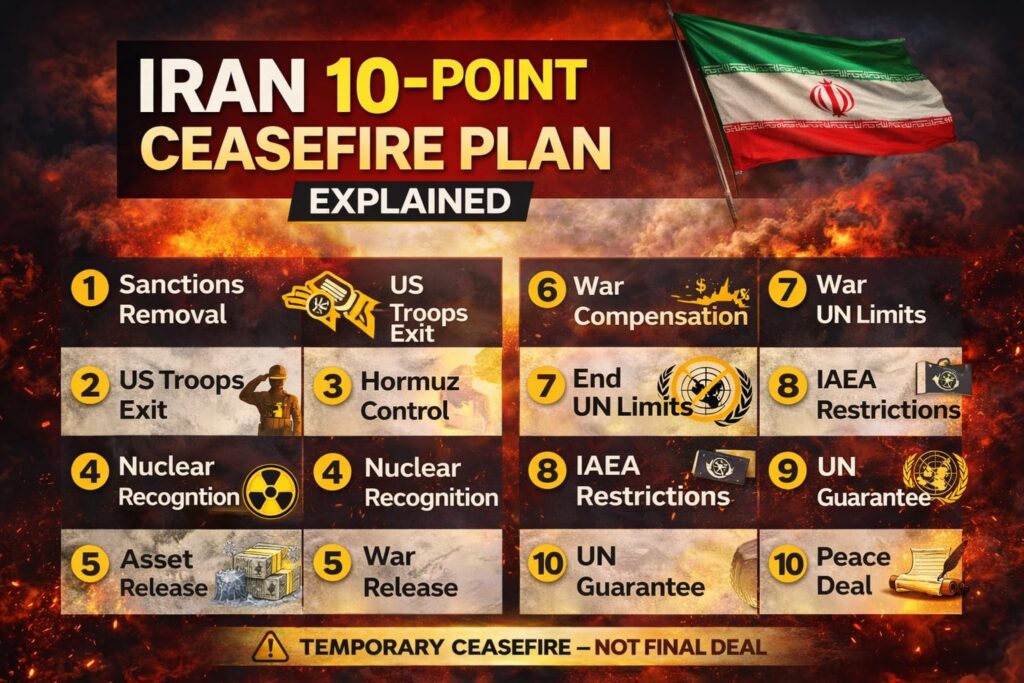
Here are the most critical points:
- Full lifting of US and international sanctions on Iran
- Withdrawal of US military forces from the Middle East
- Continued Iranian control over the Strait of Hormuz
- Acceptance of Iran’s nuclear enrichment program
- Release of frozen Iranian assets
- Compensation for war damages
- End of UN and IAEA restrictions
- Binding global agreement through the UN Security Council
Detailed reporting by
👉 The Guardian shows how close the situation was to full-scale escalation.
At the same time, Iran has agreed to reopen the Strait of Hormuz during the ceasefire, which is crucial for global oil supply.
This directly connects with my earlier breakdown of
👉 global energy crisis 2026 and fuel supply risks, where I explained how even a short disruption can trigger massive economic shock.
In my analysis, this single move helped calm global markets instantly.
When I tracked troop movement patterns, I also analyzed
👉 US troops in Middle East 2026 deployment strategy, which clearly explains how prepared both sides were before negotiations began.
As explained by
👉 Al Jazeera, the ceasefire includes multiple long-term strategic demands.
Why This Iran 10-Point Ceasefire Plan Matters
The global impact of the Iran 10-point ceasefire plan goes far beyond the battlefield, especially because it directly affects oil supply routes. When I compared this situation with past geopolitical conflicts, I noticed a major pattern:
👉 Control of energy routes = global power leverage
The Strait of Hormuz handles a massive share of the world’s oil shipments. So whoever controls it holds serious economic influence.
What makes this situation even more important:
- Global oil prices were already unstable
- Gulf countries are directly exposed
- Any disruption can impact India, Europe, and Asia
In simple terms — this is not just a regional issue, it’s a global economic risk event.
I have already seen similar patterns while covering
👉 petrol diesel price today April update, where even small geopolitical tensions caused immediate fuel price reactions.
Coverage from
👉 BBC News highlights how global markets reacted immediately to the ceasefire announcement.
Impact & Deeper Analysis Iran 10-Point Ceasefire Plan
What surprised me was how the Iran 10-point ceasefire plan gives Iran unexpected leverage despite the damage it has faced. In my analysis, this ceasefire is NOT a resolution — it’s a pause.
What People Are Missing
1. Iran Gained Leverage — Not Lost It
Even after heavy damage, Iran still controls key strategic assets and has entered negotiations from a position of strength.
2. The Deal Is Extremely Fragile
Missile alerts continued in multiple countries even after the ceasefire — meaning the ground reality hasn’t stabilized.
3. Core Issues Are Still Unresolved
- Nuclear program disagreement
- Military presence in the region
- Proxy conflicts (Hezbollah, etc.)
These are not small issues — these are war-level disagreements.
Many readers are also ignoring how this links to my previous coverage of
👉 Iran military strike involving F-15, A-10, and USS Tripoli, which showed how intense the battlefield situation had already become.
For a broader timeline, I recommend checking
👉 Iran breaking news and Middle East crisis 2026, where I tracked the full escalation step-by-step.
Live updates from
👉 CNN confirm that tensions remained high even after the agreement.
My Perspective / Expert View
From my expert perspective, the Iran 10-point ceasefire plan is more of a negotiation tool than a final peace agreement. When I deeply analyzed this entire situation, I realized something most headlines are missing:
👉 This ceasefire benefits BOTH sides — but in very different ways.
- Trump’s advantage:
Immediate de-escalation + political win + oil market stability - Iran’s advantage:
Strong negotiation position + global recognition + strategic leverage
What surprised me the most was that despite military pressure, Iran did not collapse — it adapted and negotiated aggressively.
From a strategic standpoint, I believe this is less about peace and more about resetting power balance in the Middle East.
What Happens Next?
From what I’m seeing:
- Talks are expected to begin in Islamabad with mediation support
- The US is unlikely to accept all 10 demands
- Israel’s position remains uncertain
- Any violation could restart the conflict instantly
In my analysis, the next 2 weeks are critical — they will decide whether this becomes:
👉 A long-term peace deal
👉 Or just a temporary break before a bigger war
Conclusion
After analyzing every angle of the Iran 10-point ceasefire plan, I believe this is not true peace, but a calculated pause before a much bigger geopolitical shift, I can clearly say this:
👉 This is not peace — this is a strategic pause before a bigger decision.
What happens next will reshape not just the Middle East, but global power dynamics and energy markets.
And in my view, the real story hasn’t even started yet.
FAQs
1. What is the Iran 10-point ceasefire plan?
It is a proposal by Iran outlining conditions like sanctions removal, US troop withdrawal, and nuclear program recognition in exchange for peace.
2. Has the Iran-US war ended?
No. This is only a temporary two-week ceasefire, not a permanent resolution.
3. Why is the Strait of Hormuz important?
It is one of the world’s most critical oil routes, and control over it directly impacts global energy supply.
4. Did the US accept all of Iran’s demands?
No. The US has only accepted it as a starting point for negotiations, not a final agreement.
5. Can the war start again?
Yes. The ceasefire is fragile, and any violation could lead to immediate escalation.
Also Read : More Trending News Realted News update on Trending News Adda.