
When I analysed the latest update on 18% GST on used cars, I realized most people are misunderstanding how this rule actually works.
When I looked at the recent headlines around 18% GST on used cars, I noticed that the biggest confusion was not about the tax rate itself, but about who actually has to pay it. In my analysis, many readers were left with the impression that every second-hand car sale in India would suddenly become more expensive. That is not accurate.
The key point is that the GST Council recommended a uniform 18% GST on the margin earned in sales of old and used vehicles, including EVs, and the official press release also made it clear that this does not apply to unregistered individuals selling to each other. Later, Notification No. 04/2025-Central Tax (Rate), issued on 16 January 2025, amended the earlier rate structure with immediate effect.
If you are tracking recent policy updates, you can also check my detailed breakdown on
👉 fuel price changes in India
👉 What Is Happening with 18% GST on Used Cars?
The new 18% GST on used cars is not applied the way most buyers think. In simple terms, 18% GST on used cars now applies in a more uniform way when registered businesses or dealers sell old and used vehicles, including used electric vehicles. Earlier, some used vehicles were already effectively taxed at 18%, while other categories such as many used EVs were under a lower 12% structure. The GST Council’s 55th meeting recommended bringing these categories under one uniform 18% slab on margin value, and that recommendation was later implemented through the January 2025 notification.
What surprised me was how many people assumed this meant a direct 18% tax on the full resale value of every used car. That is not what the official note says. GST applies only on the supplier’s margin—that is, the difference between purchase price and selling price, or depreciated value if depreciation has been claimed.
According to the official GST Council update and major reports from
👉 Times of India,
this change mainly impacts dealer-based transactions.
Key Details / Background
In my analysis, the 18% GST on used cars applies only when a registered dealer sells the vehicle. When I checked the official GST Council press release, it specifically said the Council recommended increasing GST from 12% to 18% on the sale of all old and used vehicles, including EVs, except those categories that were already at 18%. Those already-taxed-at-18% categories included old and used petrol vehicles with engine capacity of 1200 cc or more and length of 4000 mm or more, diesel vehicles with engine capacity of 1500 cc or more and length of 4000 mm or more, and SUVs.
I also found that the confusion over used EVs came from the contrast with new EV taxation. New electric vehicles in India continue to attract 5% GST, but used EV sales by registered businesses now fall into the broader 18% margin-based structure for old and used vehicles. That distinction matters because the tax treatment for a new EV purchase and a dealer-led resale of a used EV are now very different.
As also explained by
👉 Economic Times,
GST applies only on the margin and not the full vehicle value.
Another important detail is timing. The Council recommendation came in December 2024, and Notification No. 04/2025-Central Tax (Rate) issued on 16 January 2025 changed the rate entry from 6% CGST to 9% CGST, which effectively means the full GST moved from 12% to 18% with immediate effect under the margin scheme.
Why This Matters
This is why the 18% GST on used cars is important for buyers who prefer dealer-certified vehicles. I believe this matters because the used vehicle market in India is huge, and even a tax change that applies only on margins can influence dealer pricing, resale sentiment, and buyer behavior.
For ordinary readers, the most important takeaway is this:
- Private individual-to-individual sale: no GST
- Registered business or dealer sale: GST may apply
- Tax base: margin, not full vehicle value
- Negative margin: no GST payable on that loss situation
When I compared this with how similar tax stories are usually reported, I found that the missing nuance is always the same: a policy affecting dealer transactions gets mistaken for a policy affecting all consumers equally. Here, that difference is everything.
Impact & Deeper Analysis
The real impact of 18% GST on used cars depends on dealer margins, not total vehicle price. In my analysis, the biggest impact will likely be on the organized used-car and used-EV market, not on casual peer-to-peer sellers.
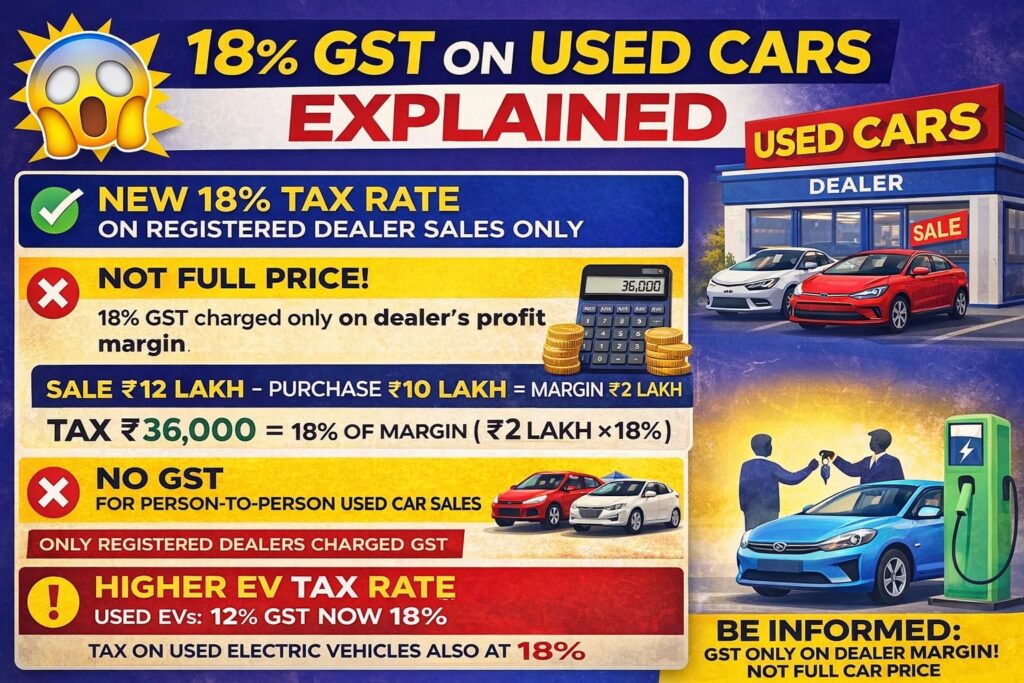
If a dealer buys a used car cheaply and resells it at a healthy margin, the 18% GST on that margin can increase the tax burden compared with the earlier 12% rate for some vehicle categories. Business Standard illustrated this simply: if a dealer buys a car for ₹9 lakh and sells it for ₹10 lakh, the GST applies only on the ₹1 lakh margin.
The Economic Times also gave a useful depreciation-based example. If a registered person sells an old vehicle for ₹10 lakh, where the purchase price was ₹20 lakh and ₹8 lakh depreciation has been claimed, the depreciated value becomes ₹12 lakh. Since the selling price is below that value, the margin is negative and no GST is payable. But if the same vehicle is sold for ₹15 lakh, GST is payable on the ₹3 lakh margin, which works out to ₹54,000 at 18%.
A similar explanation was highlighted by
👉 BusinessStandard,
which clarified how dealer margins affect taxation.
What People Are Missing
- The tax is not on the entire resale value of the vehicle.
- The tax is not for private person-to-person sales.
- The real pricing effect will depend on dealer margins, not just the headline 18% number.
Here’s what most people might miss: for used EVs, the psychological effect may be bigger than the actual tax math. Since new EVs still enjoy a low 5% GST, some buyers may feel used EVs have become less attractive even though the 18% rate applies only to dealer margin and not necessarily to the full invoice value.
That could affect resale confidence in a market that is still building trust around battery life, long-term maintenance, and second-owner value. This part is an informed market interpretation, not an official government claim. It is supported by reporting that flagged possible pressure on used EV appeal.
My Perspective / Expert View
When I compared past taxation patterns, the 18% GST on used cars looks more like a standardisation move. When I tracked the pattern behind this trend, I felt the government’s policy direction was more about tax standardisation than about targeting EV buyers specifically. The official language points to simplification and uniformity across old and used vehicles.
From an industry perspective, I think organized dealers will now have to be more transparent in how they price used cars and used EVs. A higher margin-based GST can make aggressive markups harder to hide. On the other hand, buyers may now compare dealer-listed used cars more closely against direct owner sales.
As also reported by
👉 Moneycontrol,
this rule mainly affects registered businesses and not individual sellers.
When I checked how similar products performed in price-sensitive segments, one pattern stood out: even small tax-related perception changes can alter buyer preference. In used EVs especially, resale trust is still developing. So even though the rule is narrower than many feared, the narrative around it could still affect demand.
What Happens Next?
Going forward, the 18% GST on used cars could change how dealers price second-hand vehicles. From here, I expect three things.
First, more buyers will ask dealers for clearer invoice breakups, especially on certified used EVs and premium used cars. Second, the gap between organized dealer sales and direct owner sales may become more visible. Third, content around GST on used cars, GST on used EVs, and private car sale tax rules is likely to keep trending because public confusion is still high.
I also think more state-level dealer communications and tax explainers will emerge, because many buyers still do not understand the difference between a tax on resale value and a tax on dealer margin.
Conclusion
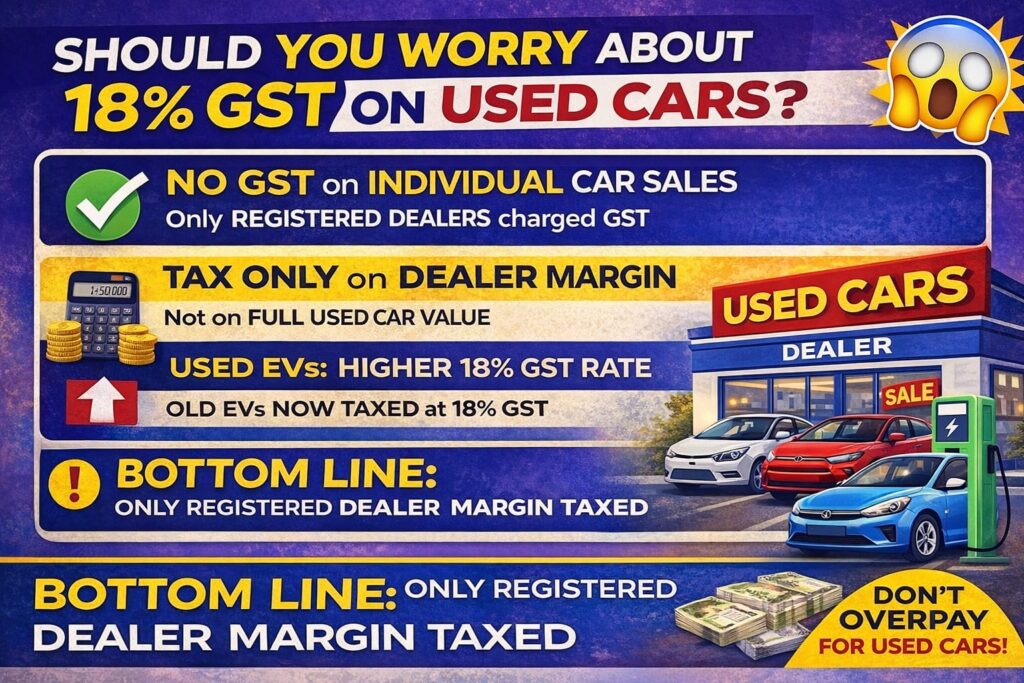
Overall, the 18% GST on used cars is not as scary as it sounds, but it will impact dealer pricing strategies. When I put all the pieces together, my conclusion is simple: the 18% GST on used cars story is real, but the panic around it has often been exaggerated. The tax is mainly relevant for registered businesses and dealers, it is charged on margin, and private used-car sales remain outside its scope.
Used EV buyers should still watch pricing carefully, but this is not a blanket tax bomb on every second-hand vehicle transaction in India. Going forward, I believe the real market story will be less about the headline rate and more about how dealers adjust pricing, transparency, and resale strategy in response.
FAQs
1. Is GST applicable when I sell my old car to another person directly?
When I checked the official clarification, the answer was no. GST is not applicable when one individual sells an old car to another individual.
2. Does 18% GST apply on the full value of a used car?
No. In my analysis, this is the biggest misunderstanding. The tax applies only on the margin of the supplier, not on the full value of the vehicle.
3. Does this new rule include used electric vehicles?
Yes. The GST Council recommendation explicitly included used EVs in the move toward a uniform 18% rate on margin for eligible business sales.
4. Are new electric vehicles also taxed at 18% GST?
No. New EVs continue to attract 5% GST. The 18% discussion here is about old and used vehicle sales by registered businesses under the margin framework.
5. When did the 18% GST change become effective?
The formal change was notified through Notification No. 04/2025-Central Tax (Rate) dated 16 January 2025, and it came into force with immediate effect.
6. Does 18% GST on used cars apply to private sellers?
No, the 18% GST on used cars does not apply to private individual-to-individual sales.
Also Read : More Business and Finance related news update on Trending News Adda.