
What Is Happening in PNG Gas Mandatory India Rule? (Overview)
PNG gas mandatory India is now becoming a major talking point across the country. When I looked closely at the latest government order, I realized this is not just a policy update — it could directly impact millions of households using LPG cylinders.
In my analysis, the government has clearly signaled that if PNG is available in your area, continuing LPG may not be allowed for long.
This situation becomes even more concerning when I connect it with the recent LPG supply concerns in India, which I covered in detail earlier.
The government has now ordered a transition to Piped Natural Gas (PNG) in areas where pipelines are already available. If households refuse to switch, they may lose LPG cylinder supply completely.
According to reports from Times of India, the government has ordered a shift to PNG wherever available.
This decision is directly linked to the ongoing global fuel crisis and supply disruptions.
Key Details of PNG Gas Mandatory India Policy
In my analysis, these are the most important confirmed rules:
- If you already have PNG connection → LPG cylinder NOT allowed
- You must surrender LPG connection immediately
- No new LPG connections will be given to PNG users
- Oil companies will stop refilling LPG cylinders for such households
As highlighted in a report by Business Today, LPG supply may stop within a limited transition period if users do not switch.
👉 Additionally, the government has made it clear:
- LPG supply may be discontinued within months if PNG is available but not adopted
What surprised me was how strict this rule is — this is not optional anymore in many cities.
Why PNG Gas Mandatory India Move Matters
When I compared this with past energy policies, this move feels much more aggressive than earlier “encouragement” campaigns.
Here’s why it matters:
🔥 1. LPG Supply Is Under Pressure
India imports a large portion of LPG, and global tensions (especially Middle East conflict) have disrupted supply chains.
🔥 2. Govt Wants Long-Term Energy Security
By shifting to PNG:
- Less dependence on imports
- More stable domestic supply
🔥 3. Cleaner Fuel Push
PNG is considered:
- More efficient
- Less polluting
- Safer than cylinders
In fact, when I analyzed global tensions and fuel price trends, I noticed a direct connection with rising costs, similar to what I explained in my petrol price today India analysis.
Impact & Deeper Analysis of PNG Gas Mandatory India
In my view, this policy will have real impact on middle-class households.
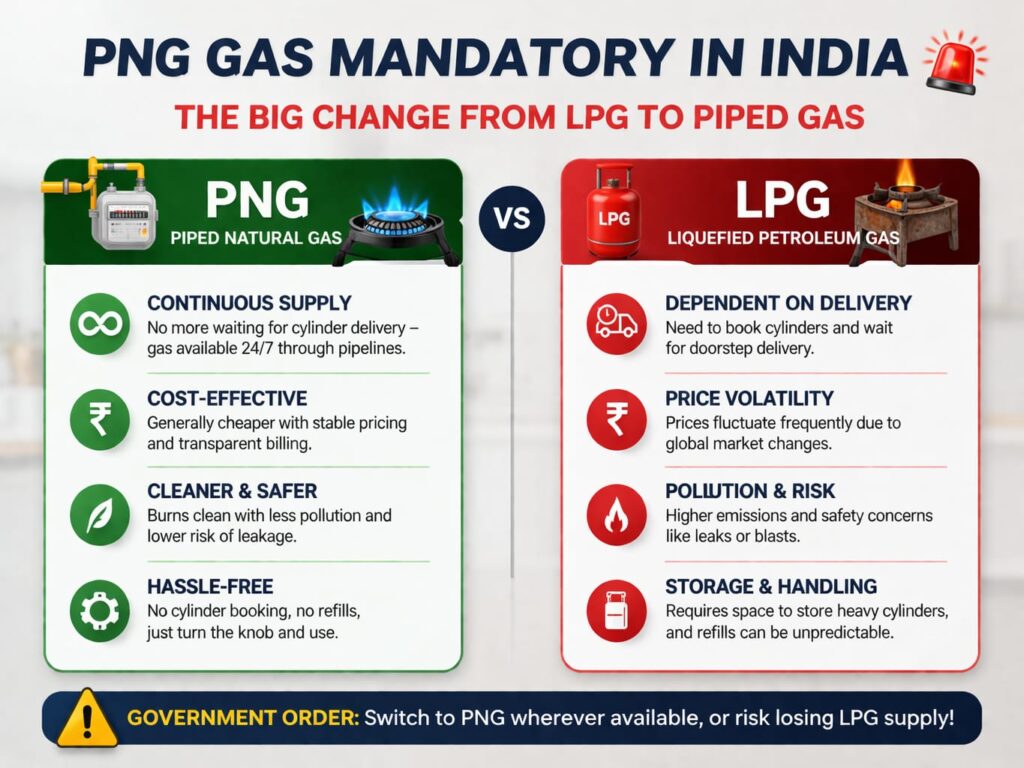
🏠 Household Level Impact
- No more cylinder booking stress
- Continuous gas supply (pipeline)
- But initial installation cost + dependency on pipeline network
📉 Market Impact
- LPG demand may drop in cities
- PNG companies will grow rapidly
What surprised me was how aggressively the PNG gas mandatory India transition is being pushed, especially when infrastructure is still uneven.
Reports from Deccan Herald also suggest that refusal to switch could lead to complete discontinuation of LPG supply.
From my perspective, this policy is also indirectly influenced by geopolitical factors like the Middle East crisis and its impact on India’s economy, which I recently broke down
⚠️ What People Are Missing
Here’s what most people are not noticing:
- Nearly 40% PNG connections still face supply issues in some areas
- Infrastructure is still incomplete in many cities
- This transition could create short-term chaos
My Perspective on PNG Gas Mandatory India Decision
When I tracked this trend closely, I noticed this is not just about cooking gas — it’s a strategic move.
I believe:
- This is a crisis-driven decision, not just policy reform
- Govt is preparing for long-term fuel shortages
- PNG will become default urban cooking fuel in India
However, I also think:
👉 Implementation will be the biggest challenge
👉 Infrastructure gaps could frustrate users
I believe the PNG gas mandatory India decision is driven more by long-term energy security than short-term convenience.
So while the idea is strong, execution will decide success.
What Happens Next in PNG Gas Mandatory India Rollout?
Based on my analysis, here’s what I expect:
- Faster rollout of PNG pipelines in cities
- More discounts / incentives for PNG connections
- Gradual phase-out of LPG in urban areas
- Strict monitoring of dual connections (PNG + LPG)
Also, government has assured:
👉 There is no immediate LPG shortage panic, but transition is coming
Conclusion
When I looked at the bigger picture, this move clearly signals one thing:
👉 India is entering a new energy phase.
The push for PNG gas mandatory is not just about convenience — it’s about energy security, global crisis response, and long-term sustainability.
But here’s my final take:
⚠️ If infrastructure doesn’t keep up, this could become a major public issue.
Otherwise, this shift could completely change how Indian kitchens operate in the next 5–10 years
The reality is clear — PNG gas mandatory India could soon redefine cooking fuel across major cities.
If you want to understand how fuel policies are evolving in India, I strongly recommend checking my detailed breakdown of India’s fuel and energy crisis trends
FAQs
1. Is LPG banned in India in 2026?
No, LPG is not fully banned. But if PNG is available in your area, LPG may be stopped for you.
2. Can I keep both PNG and LPG connection?
No. Government rules clearly say you must surrender LPG if you have PNG.
3. How much time is given to switch?
Reports suggest around 3 months transition period in some cases (not officially fixed for all areas).
4. Is PNG cheaper than LPG?
Generally, PNG is:
Slightly cheaper
More stable in pricing
5. What if PNG is not available in my area?
You can continue using LPG normally.
Also Read : more Trending News Related news update on Trending News Adda.