
Artificial Intelligence is evolving faster than most people realize. When I looked at the biggest technology trends shaping 2026, one pattern became impossible to ignore — AI tools are no longer experimental; they are becoming everyday productivity engines. When I looked at the biggest technology trends shaping this year, one thing became clear — AI tools in 2026 are transforming how people work and create online.
In my analysis, the AI tools in 2026 are doing far more than simple automation. They are writing content, generating code, designing images, analyzing data, and even acting as digital assistants that collaborate with humans.
What surprised me the most was how quickly these tools moved from “interesting technology” to “essential digital infrastructure.” For creators, developers, marketers, and businesses, the right AI tools can dramatically increase productivity.
So I decided to analyze some of the most powerful AI tools shaping 2026. Here are the ones that stand out the most. In my analysis, AI tools in 2026 are transforming how people work, create content, and automate tasks across industries.
What Is Happening? (Overview)
The AI industry is entering a new phase where tools are becoming platforms for productivity and creativity.
When I tracked the pattern behind this trend, I noticed three key developments:
- AI models are becoming multimodal (text, image, video, audio together).
- AI assistants are starting to perform tasks rather than just answer questions.
- Businesses are integrating AI tools into daily workflows and automation systems.
Major technology companies such as Microsoft, OpenAI, Google, and Anthropic are pushing the boundaries of AI capabilities. According to industry discussions and official technology roadmaps, 2026 could be the year AI becomes a default workplace tool.
Key Details / Background
When I compared current tools with early AI systems from just a few years ago, the improvement is dramatic.
Earlier AI tools were limited to basic tasks. But modern AI productivity tools in 2026 can:
- Generate long-form content
- Build applications
- Create high-quality visuals
- Analyze complex datasets
- Automate workflows
Many of these tools are powered by large language models (LLMs) or generative AI models, which learn patterns from massive datasets.
Industry reports and company announcements suggest that AI adoption across industries is accelerating, especially in technology, marketing, design, finance, and education. The rapid growth of AI tools in 2026 shows how artificial intelligence is becoming part of everyday workflows, from writing and coding to design and data analysis.
According to industry insights shared in Microsoft’s official AI research, several major trends are shaping the future of artificial intelligence.
Link : https://news.microsoft.com/source/features/ai/whats-next-in-ai-7-trends-to-watch-in-2026/
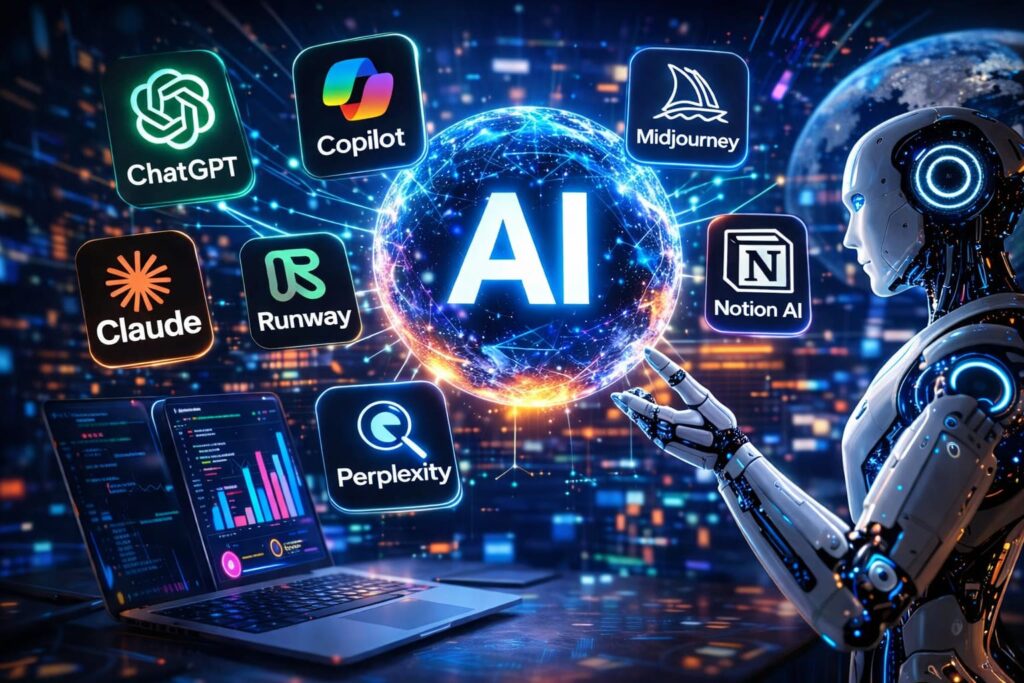
7 Powerful AI Tools Everyone Should Know in 2026
1. ChatGPT
When I analyzed productivity tools used by creators and businesses, ChatGPT consistently appeared at the top.
This AI assistant helps with:
- Writing articles and emails
- Coding and debugging
- Research summaries
- Brainstorming ideas
- Learning new concepts
The latest versions are becoming more capable of multi-step reasoning and automation, making them useful for both professionals and students.
2. Microsoft Copilot
Microsoft has integrated Copilot AI across many of its products including:
- Microsoft Word
- Excel
- PowerPoint
- Outlook
- Windows
In my analysis, Copilot represents the enterprise version of AI productivity.
For example, it can:
- Summarize documents
- Generate presentations
- Analyze spreadsheets
- Draft emails automatically
This shows how AI is moving directly into everyday office tools.
3. Midjourney
Visual creation is another area where AI tools are transforming workflows.
Midjourney is widely used for AI image generation, allowing users to create stunning visuals from simple prompts.
Designers, marketers, and content creators use it for:
- Social media graphics
- Concept art
- Marketing visuals
- Product design inspiration
When I compared AI design tools, Midjourney still stands out for high-quality artistic output.
4. Runway AI
Runway is pushing AI into video creation and editing, which could dramatically change content production.
Its tools can:
- Generate AI videos
- Edit footage automatically
- Remove backgrounds
- Create visual effects
In my analysis, AI video generation could become one of the largest AI industries in the next decade, especially for creators and marketing teams.
5. Claude AI
Claude AI, developed by Anthropic, is another major AI assistant competing with leading models.
What makes Claude interesting is its focus on:
- Safety
- Long-form reasoning
- Large document analysis
When I tested similar tools, Claude performed especially well when analyzing long reports or complex topics.
6. Perplexity AI
Perplexity AI is becoming a powerful AI-driven search engine.
Instead of showing just links like traditional search engines, it provides direct answers with citations.
This changes how people find information online.
In my view, tools like Perplexity represent a shift from search engines to “answer engines.”
7. Notion AI
Productivity platforms are also becoming AI-powered.
Notion AI helps users with:
- Note organization
- Writing assistance
- Task management
- Knowledge management
For startups, creators, and teams, this tool is turning into a central productivity hub powered by AI.
Industry analysts have also highlighted several emerging AI platforms transforming productivity tools.
Link : https://medium.com/ai-analytics-diaries/top-7-ai-tools-in-2026-9784e67de643
Why This Matters
When I analyzed technology adoption patterns, one thing became clear — AI tools are not replacing humans; they are augmenting human productivity.
These tools allow people to:
- Complete tasks faster
- Generate ideas instantly
- Automate repetitive work
- Focus on high-value thinking
For businesses, AI could significantly improve efficiency, decision-making, and innovation speed. What makes AI tools in 2026 so impactful is their ability to dramatically improve productivity for individuals, creators, and businesses. The rapid adoption of AI tools in 2026 also suggests that businesses and individuals who learn to use these technologies early could gain a major competitive advantage.
Apple’s long-term strategy has always focused on bringing more users into its ecosystem. Once someone buys a MacBook, they are far more likely to use other Apple devices like the iPhone, AirPods, or iPad. In fact, Apple recently expanded its affordable device lineup as well. If you want to understand this strategy in more detail, you can read my full analysis of Apple’s new affordable laptop strategy in the MacBook Neo launch.
MacBook Neo launch : https://trendingnewsadda.com/macbook-neo-launch/
Impact & Deeper Analysis
What People Are Missing
Many discussions about AI focus only on automation, but the deeper impact is more interesting.
Here are three insights most people overlook:
1️⃣ AI is becoming a collaboration tool, not just automation.
Humans and AI are starting to work together.
2️⃣ Creativity is being amplified.
Designers, writers, and developers can experiment faster than ever.
3️⃣ AI literacy will become a career skill.
Understanding how to use AI tools may soon be as important as basic computer skills.
When I tracked the pattern behind major technology shifts — from the internet to smartphones — the tools that win are those that improve everyday productivity. When I studied the adoption trends, it became clear that AI tools in 2026 are no longer optional tools — they are becoming essential digital assistants.
AI tools are following the same path.
My Perspective / Expert View
After analyzing the rise of AI tools in 2026, I believe we are witnessing a major transformation in how digital work happens.
When I compared this shift with the early days of cloud computing, the similarities are striking. At first, companies experimented cautiously. Then suddenly, adoption exploded.
AI tools appear to be reaching that tipping point right now.
However, it’s important to note that not every AI claim is proven yet. Some future capabilities discussed in industry reports remain speculative until officially released. From my perspective, the rise of AI tools in 2026 is similar to the early days of the smartphone revolution, when new technology suddenly became essential for everyday work.
Still, the direction is clear — AI is becoming a core digital skill.
What Happens Next?
Looking ahead, several developments could shape the next phase of AI tools:
- More autonomous AI agents
- AI integration into operating systems
- Improved video and voice generation
- AI-powered software development
If current trends continue, the next few years could bring even more powerful AI assistants capable of managing complex workflows.
Conclusion
After studying the rapid rise of AI tools in 2026, one thing is becoming clear — artificial intelligence is no longer just a technology trend.
It is becoming a core part of how modern work gets done.
From writing and coding to design and research, these tools are transforming how people create and collaborate. Looking ahead, the evolution of AI tools in 2026 could redefine how humans collaborate with technology in the coming years.
And if the current pace of innovation continues, the AI tools we see today may only be the beginning of a much larger transformation. As innovation accelerates, AI tools in 2026 may soon become as common as search engines and smartphones in our daily digital lives.
FAQs
1. What are the best AI tools in 2026?
Some of the most powerful AI tools include ChatGPT, Microsoft Copilot, Midjourney, Runway AI, Claude AI, Perplexity AI, and Notion AI.
2. Are AI tools replacing human jobs?
AI tools mainly automate repetitive tasks. In most industries they act as productivity assistants rather than full replacements.
3. Which AI tool is best for content creation?
ChatGPT and Notion AI are widely used for writing, while Midjourney is popular for generating visuals.
4. Are AI tools free to use?
Many AI tools offer free versions, but advanced features often require paid subscriptions.
5. Why are AI tools becoming so popular?
Because they help people work faster, automate tasks, and generate ideas quickly.
Also Read : Technology and AI related News on Trending News Adda.